
Our Chairman of the Board, Mehmet Altay YEGİN’s article titled ‘Like Nasrettin Hodja’s Tomb’ has been published in Nasıl Bir Ekonomi newspaper.
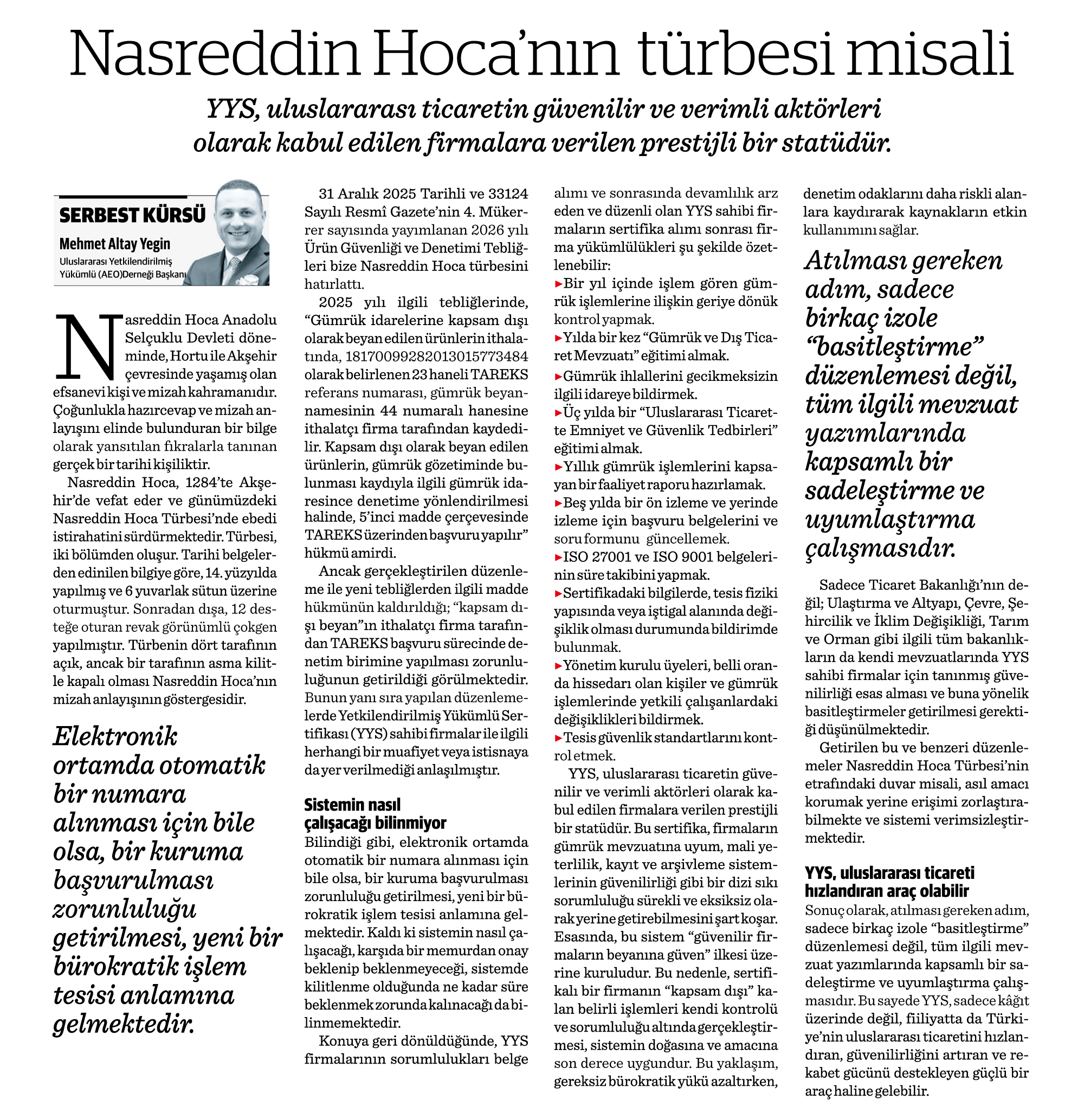
Like the Tomb of Nasreddin Hodja
Nasreddin Hodja is a legend and a humorous hero who lived in the Hortu and Akşehir regions during the Anatolian Seljuk Empire. He is a real historical figure known for his witty and humorous anecdotes, often portrayed as a wise man with a quick wit and a keen sense of humor.
Nasreddin Hodja passed away in Akşehir in 1284 and continues to rest in peace in what is now known as the Nasreddin Hodja Tomb. The tomb consists of two sections. According to historical documents, it was built in the 14th century and rests on six round columns. Later, a polygonal structure resembling a portico, resting on 12 supports, was added to the exterior. The fact that the tomb is open on four sides but closed on one side with a padlock is indicative of Nasreddin Hodja's sense of humor.
The 2026 Product Safety and Inspection Notifications published in the 4th supplementary issue of the Official Gazette dated December 31, 2025, and numbered 33124 reminded us of Nasreddin Hodja's tomb.
In the relevant notifications for 2025, clause “When importing products declared as non-covered to customs authorities, the 23-digit TAREKS reference number specified as 18170099282013015773484 is recorded by the importer in field 44 of the customs declaration. If products declared as exempt are subject to customs supervision and are referred for inspection by the relevant customs authority, an application is made through TAREKS in accordance with Article 5.” was valid.
However, with the amendment made, it is seen that the relevant provision has been removed from the new notifications; the requirement for the importer company to make a “declaration of exclusion” to the inspection unit during the TAREKS application process has been introduced. In addition, it is understood that the amendments do not include any exemptions or exceptions for AEO-Certified companies.
As it is already known, requiring individuals to apply to an institution even to obtain an automatic number in an electronic environment amounts to establishing a new bureaucratic process. Moreover, it is unclear how the system will function; whether approval from an official will be required, and how long one will have to wait in the event of a system lockup.
Returning to the subject, the responsibilities of AEO companies regarding document acquisition and the ongoing and regular obligations of AEO-certified companies after obtaining certification can be summarized as follows:
- Conducting retrospective checks on customs transactions processed within one year.
- Completing “Customs and Foreign Trade Legislation” training once a year.
- Reporting customs violations to the relevant authority without delay.
- Taking a training session on “Security and Safety Measures in International Trade” once every three years.
- Preparing an activity report covering annual customs transactions.
- Updating the application documents and questionnaire for pre-monitoring and on-site monitoring once every five years.
- Keeping track of the validity periods of ISO 27001 and ISO 9001 certificates.
- Notifying any changes in the information on the certificate, the physical structure of the facility, or the field of activity.
- Notifying changes in the members of the board of directors, persons holding a certain percentage of shares, and employees authorized to perform customs procedures.
- Checking facility security standards
The Authorized Economic Operator certificate is a prestigious status granted to companies recognized as reliable and efficient actors in international trade. This certificate requires companies to consistently and fully comply with a series of strict responsibilities, such as customs legislation, financial adequacy, and the reliability of their record-keeping and archiving systems. Essentially, this system is based on the principle of “trusting the declarations of reliable companies.” Therefore, it is entirely consistent with the nature and purpose of the system for a certified company to carry out certain “exempt” transactions under its own control and responsibility. This approach reduces unnecessary bureaucratic burdens while shifting the focus of inspections to riskier areas, ensuring the efficient use of resources.
It is believed that not only the Ministry of Trade, but also all relevant ministries such as Transportation and Infrastructure, Environment, Urbanization and Climate Change, Agriculture and Forestry should base their regulations on the recognized reliability of AEO-certified companies and introduce simplifications accordingly.
These and similar regulations, like the wall around Nasrettin Hodja's Tomb, may hinder access rather than protect the main objective and render the system inefficient.
In conclusion, the necessary step is not just a few isolated “simplification” regulations, but a comprehensive simplification and harmonization effort across all relevant legislation. This will enable the Authorized Economic Operator Certificate to become a powerful tool that not only exists on paper but also accelerates Türkiye's international trade, enhances its reliability, and supports the nation's competitiveness in practice.
Mehmet Altay YEGİN
International Authorized Economic Operator (AEO) Association
Chairman of the Board