Legislation Announcements
EU – Türkiye Authorized Economic Operator (AEO/CEO) Mutual Recognition Decision (Draft)
Council Decision (EU) 2025/2516 of 4 December 2025 on the position to be taken on behalf of the European Union within the Customs Cooperation Committee established under the Agreement establishing an Association between the European Community and Turkey as regards the adoption of a decision concerning the mutual recognition of the authorised economic operator programme of the Union and the authorised economic operator programme of the Republic of Türkiye
THE COUNCIL OF THE EUROPEAN UNION,
Having regard to the Treaty on the Functioning of the European Union, and in particular Article 207(4), first subparagraph, in conjunction with Article 218(9) thereof,
Having regard to the proposal from the European Commission,
Whereas:
|
(1) |
The Agreement establishing an Association between the European Community and Turkey (the ‘Association Agreement’) was signed at Ankara on 12 September 1963. It defines the scope and content of the association relationship. Rules concerning the final phase of the EU–Türkiye Customs Union are laid down in Decision No 1/95 of the EC-Turkey Association Council of 22 December 1995, which entered into force on 31 December 1995 (‘Decision No 1/95’). |
|
(2) |
The EC-Turkey Association Council (the ‘Association Council’) was set up pursuant to Article 6 of the Association Agreement. Pursuant to Article 24 of the Association Agreement, the Association Council may decide to set up committees to assist in the performance of its tasks. |
|
(3) |
Decision No 2/69 of the Association Council of 15 December 1969 (‘Decision No 2/69’) established the Customs Cooperation Committee. |
|
(4) |
Article 2 of Decision No 2/69 stipulates that ‘the Customs Cooperation Committee shall be responsible for ensuring administrative cooperation between the Contracting Parties with a view to the correct and uniform application of the customs provisions of the Association Agreement and for carrying out any other tasks in the customs field which the Association Committee may entrust to it’. |
|
(5) |
Pursuant to Article 28(3) of Decision No 1/95, the Customs Cooperation Committee is to lay down the appropriate measures to implement the customs provisions contained in that Article. |
|
(6) |
Security and safety, and the facilitation of the international trade supply chain, can be significantly enhanced through mutual recognition of the respective trade partnership programmes, namely of the authorised economic operator (AEO) programme of the Union and the national AEO programme of the Republic of Türkiye (‘Türkiye’). |
|
(7) |
The two AEO programmes are based on internationally recognised security standards advocated by the SAFE Framework of Standards to Secure and Facilitate Global Trade adopted by the World Customs Organization in June 2005 (‘SAFE Framework’). |
|
(8) |
Mutual recognition allows the Contracting Parties to provide facilitative benefits to economic operators who have invested in supply-chain security and have been authorised under their respective programmes. |
|
(9) |
Site visits and a joint evaluation of the AEO programmes in the Union and in Türkiye have revealed that their qualification standards for security and safety purposes are compatible and lead to equivalent results. |
|
(10) |
The Customs Cooperation Committee during its meeting in 2026 or by written procedure if the Contracting Parties so agree, is to adopt a decision concerning the mutual recognition of the AEO programme (security part) of the Union and the AEO programme of Türkiye. |
|
(11) |
It is appropriate to establish the position to be taken on the Union’s behalf within the Customs Cooperation Committee as its decision on mutual recognition of the AEO programmes will have legal effects, |
HAS ADOPTED THIS DECISION:
Article 1
The position to be taken on the Union’s behalf within the Customs Cooperation Committee established under the Agreement establishing an Association between the European Community and Turkey as regards the adoption of a decision on the mutual recognition of the authorised economic operator programme of the Union and the authorised economic operator programme of the Republic of Türkiye shall be based on the draft decision of the Customs Cooperation Committee attached to this Decision.
Article 2
This Decision shall enter into force on the date of its adoption.
Done at Brussels, 4 December 2025.
For the Council
The President
- DANIELSEN
DRAFT
DECISION No …/2026 OF THE EU – TÜRKİYE CUSTOMS COOPERATION COMMITTEE
of …
concerning the mutual recognition of the authorised economic operator programme of the European Union and the authorised economic operator programme of the Republic of Türkiye
THE CUSTOMS COOPERATION COMMITTEE,
HAVING REGARD TO the Agreement establishing an Association between the European Community and Turkey signed at Ankara on 12 September 1963 (1) and in particular Articles 2(1) and 7 thereof, and to Decision No 1/95 of the EC-Turkey Association Council of 22 December 1995 on implementing the final phase of the Customs Union (2), and in particular Article 28(1), point (c) and Article 28(3) thereof,
Whereas:
|
(1) |
Article 2(1) of the Agreement establishing an Association between the European Community and Turkey signed at Ankara on 12 September 1963 (the ‘Association Agreement’) establishes that ‘the aim of this Agreement is to promote the continuous and balanced strengthening of trade and economic relations between the Parties’. |
|
(2) |
Article 7 of the Association Agreement stipulates that ‘the Contracting Parties shall take all appropriate measures, whether general or particular, to ensure the fulfilment of the obligations arising from this Agreement’. |
|
(3) |
Article 28(1), point (c), of Decision No 1/95 of the EC-Turkey Association Council of 22 December 1995 (the ‘Customs Union Decision’) establishes that the Republic of Türkiye (‘Türkiye’) is to adopt provisions based on the Community Customs Code and its implementing provisions in the field of, among others, introduction of goods into the territory of the Customs Union. |
|
(4) |
Article 28(3) of the Customs Union Decision establishes that the Customs Cooperation Committee is to lay down the appropriate measures to implement such provisions. |
|
(5) |
Security and safety, and the facilitation of the international trade supply chain, can be significantly enhanced through mutual recognition of the respective trade partnership programmes, namely of the authorised economic operator (AEO) programme of the Union and the national AEO programme of Türkiye. |
|
(6) |
The two AEO programmes are based on internationally recognised security standards advocated by the SAFE Framework of Standards to Secure and Facilitate Global Trade adopted by the World Customs Organization in June 2005 (‘SAFE Framework’). |
|
(7) |
Mutual recognition allows the Contracting Parties to provide facilitative benefits to economic operators who have invested in supply-chain security and have been authorised under their respective programmes. |
|
(8) |
Site visits and a joint evaluation of the AEO programmes in the Union and in Türkiye have revealed that their qualification standards for security and safety purposes are compatible and lead to equivalent results. |
|
(9) |
Decision 2/69 of the EC-Turkey Association Council of 15 December 1969 establishing the Customs Cooperation Committee (3) and in particular Article 2 thereof, stipulates that the Customs Cooperation Committee is to be responsible for ensuring administrative cooperation between the Contracting Parties with a view to the correct and uniform application of the customs provisions of the Association Agreement and for carrying out any other tasks in the customs field which the Association Committee may entrust to it, |
HAS ADOPTED THIS DECISION:
Article 1
Definitions
For the purposes of this Decision, the European Union (the ‘Union’) and the Republic of Türkiye (‘Türkiye’) are each individually referred to as a ‘Party’ or collectively as ‘Parties’, and the following definitions apply:
|
(1) |
‘Customs Authority’ means the customs authority of a Member State of the Union or the customs authority of Türkiye, hereinafter referred to collectively as ‘Customs Authorities’; |
|
(2) |
‘Economic operator’ means a person involved in the international movement of goods; |
|
(3) |
‘Personal data’ means any information relating to an identified or identifiable natural person (‘data subject’); an identifiable natural person is one who can be identified, directly or indirectly, in particular by reference to an identifier such as a name, an identification number, location data, an online identifier or to one or more factors specific to the physical, physiological, genetic, mental, economic, cultural or social identity of that natural person; |
|
(4) |
‘Programme’ means:
|
|
(5) |
‘Programme Members’means economic operators holding AEO status in the Union and economic operators holding membership status in Türkiye as referred to in point (4) when referred to collectively. |
Article 2
Mutual recognition and implementation of this Decision
- The Programmes of the Union and of Türkiye are hereby mutually recognised to be compatible and the corresponding AEO statuses granted are mutually accepted.
- The Parties shall implement this Decision through their respective Customs Authorities.
Article 3
Compatibility
- The Customs Authorities shall cooperate to maintain the compatibility between their Programmes, in particular with respect to the following matters:
|
(a) |
the application process for granting the AEO status and membership; |
|
(b) |
the assessment of applications; |
|
(c) |
the granting of the AEO status and membership; |
|
(d) |
the managing, monitoring, suspension, re-assessment, and revocation of the AEO status and membership; |
|
(e) |
promoting cooperation between Customs Authorities and environmental authorities to promote AEO status and membership compliance with international environmental standards. |
- The Parties shall ensure that their trade partnership programmes operate within the relevant standards of the SAFE Framework.
Article 4
Benefits
- Each Customs Authority shall provide benefits to Programme Members of the other Customs Authority that are comparable to the benefits that it provides to its Programme Members.
- The benefits referred to in paragraph 1 include:
|
(a) |
fewer security and safety-related controls: each Customs Authority takes the status of a Programme Member granted by the other Customs Authority favourably into account in its risk assessment in order to reduce inspections or controls and in other security and safety-related measures; |
|
(b) |
the giving of priority to the inspection of consignments covered by exit or entry summary declarations and transit declarations that include same data elements required for entry or exit summary declarations, lodged by a Programme Member if the Customs Authority decides to proceed with an inspection; |
|
(c) |
the recognition of business partners status during the application process: each Customs Authority takes the status of a Programme Member granted by the other Customs Authority into account with a view to treating the Programme Member as a secure and safe partner when assessing the business partners’ requirements for applicants under its own Programme; |
|
(d) |
business continuity mechanism: both Customs Authorities endeavour to establish a business continuity mechanism to respond to disruptions in trade flows due to increases in security alert levels, border closures or natural disasters, hazardous emergencies or other major incidents, by which priority cargos related to Programme Members should be facilitated and expedited to the extent possible by the Customs Authorities. |
- Following the review process referred to in Article 7(5), each Customs Authority may provide, in cooperation with other government authorities in its territory, further facilitation benefits, which may include streamlining processes and increasing the predictability of movement at the border, to the extent possible, such as by establishing fast track lanes at land borders.
- Each Customs Authority:
|
(a) |
may suspend the benefits provided under this Decision to a Programme Member of the other Customs Authority only for duly justified reasons equivalent to those for which it would suspend a Programme Member from its Programme, such as when the Programme Member is found to be involved in a safety and security related incident; |
|
(b) |
shall, within a reasonable time, communicate the suspension operated under point (a) and the reasons for the suspension to the other Customs Authority via the competent services of the European Commission. |
- Each Customs Authority shall, when it deems appropriate, report irregularities via the competent services of the European Commission involving Programme Members of the other Customs Authority’s Programme to that Customs Authority for the purpose of ensuring immediate analysis of the appropriateness of the benefits and status granted by the other Customs Authority.
- For greater certainty, this Decision does not limit a Party or a Customs Authority from requesting information pursuant to the mutual administrative assistance referred to in Annex 7 to the Customs Union Decision or other applicable instrument between the Parties, or between the Customs Authorities.
Article 5
Exchange of information and communication
- The Parties shall enhance their communication in order to implement this Decision effectively by:
|
(a) |
providing each other with the details on their Programme Members in accordance with paragraph 3; |
|
(b) |
providing each other with updates on the operability and development of their Programmes in a timely manner; |
|
(c) |
exchanging information regarding supply-chain security policy and trends; and |
|
(d) |
ensuring effective communication through the competent services of the European Commission and the Customs Authority of Türkiye to enhance risk-management practices with respect to supply-chain security. |
- The exchange of information and communication in the framework of this Decision shall occur between the competent services of the European Commission and the Customs Authority of Türkiye.
- Upon receiving consent from its Programme Member, each Party shall send to the other Party the following details about that Programme Member:
|
(a) |
name; |
|
(b) |
address; |
|
(c) |
membership status, namely authorised, suspended, revoked or cancelled; |
|
(d) |
validation or authorisation date when available; |
|
(e) |
unique identification number (for example: EORI or AEO numbers); and |
|
(f) |
other details that may be mutually determined between the Parties in writing, subject, when applicable, to any necessary safeguards. |
- The details referred to in paragraph 3, point (c) do not include the reasons for suspension, revocation or cancellation.
- The Parties shall exchange the information referred to in paragraph 3 in a systematic manner by electronic means.
- Each Customs Authority may share its national contact points in order to handle any issues relating to the clearance of goods of Programme Members.
Article 6
Data Protection
- Each Customs Authority shall use personal data under this Decision only if and to the extent necessary for the implementation of this Decision, including monitoring and reporting.
- Each Customs Authority shall obtain the prior written approval from the communicating Customs Authority that sent the information (the ‘communicating Customs Authority’) to use that information for other purposes. Such use shall be subject to any restrictions laid down by that authority.
- Notwithstanding paragraph 2, the Customs Authority that has received the information under this Decision (‘the receiving Customs Authority’) may use that information in any judicial or administrative proceedings instituted for failure to comply with its customs legislation, including in its records of evidence, reports and testimonies. The receiving Customs Authority shall notify the communicating Customs Authority prior to such use.
- Each Customs Authority shall apply the following minimum safeguards to the processing of personal data received from the other Customs Authority:
|
(a) |
personal data must be processed lawfully, fairly, and in a transparent manner in relation to the concerned Programme Members; |
|
(b) |
personal data must be collected and processed for the specified, explicit and legitimate purpose of implementing this Decision and not be further processed by the communicating Customs Authority or by the receiving Customs Authority in a way incompatible with that purpose; |
|
(c) |
personal data must be accurate and kept up to date; |
|
(d) |
personal data must be kept in a form which permits the identification of Programme Members for no longer than it is necessary for the purpose for which the data were collected or for which they are further processed; |
|
(e) |
information received under this Decision must be processed in a manner that ensures appropriate security of the personal data, taking into account the specific risks of processing, including protection against unauthorised or unlawful processing and against accidental loss, destruction or damage, using appropriate technical or organisational measures; the receiving Customs Authority shall take appropriate measures to address any data breach, and shall notify the communicating Customs Authority of such breach without undue delay; |
|
(f) |
both the communicating Customs Authority and the receiving Customs Authority shall take every reasonable step to ensure without delay the rectification or erasure, as appropriate, of personal data where the processing does not comply with this Article, in particular because those data are not adequate, relevant, accurate, or they are excessive in relation to the purpose of processing. This includes the notification of any rectification or erasure to the other Customs Authority; |
|
(g) |
upon request, the receiving Customs Authority shall inform the communicating Customs Authority of the use of the communicated data and about the implementation of the safeguards with respect to these data; |
|
(h) |
the communicating and the receiving Customs Authorities are under an obligation to make a written record of the communication and receipt of personal data; |
|
(i) |
Programme Members shall, subject to necessary and proportionate limitations established by law to protect important grounds of public interest, have the right to receive information on the processing of their personal data, to access such data and to have inaccurate or unlawfully processed data rectified or erased; |
|
(j) |
Programme Members shall have the right, without prejudice to any other administrative or non-judicial remedy, to an effective judicial remedy for the violation of the aforementioned safeguards. |
- Each Customs Authority shall promptly notify the other Customs Authority if it determines that information it has sent to the other Customs Authority is inaccurate, incomplete or unreliable, or if its receipt or further use contravenes this Decision.
- Each Customs Authority shall provide Programme Members access, as it relates to their personal data, to administrative redress or judicial review regardless of their nationality or country of residence.
- The Customs Authorities shall publish information to inform Programme Members of their options of seeking administrative redress or judicial review.
- Compliance with this Article by each Customs Authority is subject to supervision by their competent independent authority, which ensures oversight and that complaints relating to non-compliance in the treatment of information are received, investigated, responded to and appropriately redressed. Those authorities are:
|
(a) |
in the Union: the European Data Protection Supervisor or its successor, and the Member States’ data protection authorities; |
|
(b) |
in Türkiye: the Personal Data Protection Authority (KVKK) of the Republic of Türkiye. |
Article 7
Implementation, consultation, monitoring and review
- The Parties shall resolve any issues related to the implementation of this Decision through consultations under the auspices of the Customs Cooperation Committee.
- Both Parties shall cooperate closely regarding the implementation of this Decision and shall monitor this regularly by means of periodical on-site joint monitoring visits to identify possible strengths and weaknesses in the Programmes of both Parties.
- In particular, both Parties shall closely cooperate regarding the implementation of Article 3 and will inform each other of any updates or changes to their Programmes, they will assess whether these changes might impact the compatibility of the Programmes of both Parties including through on-site joint monitoring visits and, where necessary, will take measures to ensure continued compatibility of the Programmes.
- Both Parties shall closely cooperate to ensure the use of this Decision by the Programme Members.
- The Customs Cooperation Committee shall review the implementation of this Decision regularly. This review process may include, in particular:
|
(a) |
exchanges of views on details exchanged and benefits referred to in Article 4 granted to Programme Members, including any future details or benefits; |
|
(b) |
exchanges of views on details of the management of the AEO status, e.g. monitoring, re-assessment, suspension and revocation; |
|
(c) |
exchanges of views on security provisions such as protocols to be followed during and after a serious security incident (business resumption) or when conditions merit suspension of mutual recognition; |
|
(d) |
examination of the suspension of the benefits referred to in Article 4; |
|
(e) |
review of the implementation of Article 6; and |
|
(f) |
any changes to the Programmes of the Parties. |
Article 8
Final provisions
- The Customs Cooperation Committee may amend this Decision. The amendment shall enter into force in accordance with the procedure described in Article 9.
- A Party may suspend cooperation under this Decision at any time by providing the other Party with 30 days’ written notice. Notwithstanding the suspension of the cooperation under this Decision, the Customs Authorities of both Parties shall continue to comply with Article 6 in order to ensure the protection of information.
- Either Party may terminate this Decision at any time by notifying the other Party through diplomatic channels. This Decision shall be terminated 30 days after the written notification is received by the other Party. Notwithstanding the termination of this Decision, the Customs Authorities shall continue to comply with Article 6 in order to ensure the protection of information.
- In case of termination, either of the Parties is entitled to require that the information which it has communicated, together with any backups thereof, be returned to the communicating Party or deleted in its entirety. The Party responsible for the deletion shall certify the deletion of the information to the other Party. Until the information is deleted or returned, the receiving Party shall continue to ensure compliance with Article 6. In case local laws applicable to the receiving Party prohibit the return or deletion of the communicated information, the receiving Party warrants that it will continue to ensure compliance with Article 6 and will process the information only to the extent and for as long as required under that local law.
Article 9
Entry into force
This Decision shall enter into force on the first day of the month following the date on which the Parties have notified each other of the completion of their own procedures necessary for its entry into force.
Done at …, on …
For the Customs Cooperation Committee
The President
YYSD Legislation -Customs and Foreign Trade Bulletin
“Authorized Customs Consultancy Guide” and “Authorized Customs Consultancy Working Guide”, which determine the procedures and principles regarding the implementation of the Authorized Customs Consultancy Communiqué (amended by the Communiqué on Amendments to the Authorized Customs Consultancy Communiqué published in the Official Gazette dated 11/1/2024 and numbered 32426). Circular No. 2024/8, which includes the "Region", was published.
Additions related to YYS are as follows.
9.3.3 Handling Activities Outside the Warehouse
Conditions for Handling Operations Outside the Warehouse:
For handling operations to be carried out outside the warehouse, the company owning the goods must have an Authorized Economic Operator Certificate or meet the following conditions.
Handling Activities to be Performed Individually Outside the Warehouse:
In the handling activities to be carried out in this context, the goods leaving the warehouse must be returned to the warehouse within 3 months. This period may be extended for a period not exceeding 3 months by the Regional Directorate to which the supervisory customs administration is affiliated, if there are justified reasons. In addition, if the handling activity is related to the goods used in the defense industry and aviation sector within the scope of Article 334/4 of the Customs Regulation and the owner of the goods in question has an Authorized Economic Operator Certificate, provided that there are justified grounds, the period of not exceeding 6 months by the Regional Directorate where the handling permit is given in addition to the total period of 6 months. Additional time may be given.
Common Provisions Regarding Handling Activities Outside the Warehouse:
A guarantee equal to the customs duties that may accrue for goods not in free circulation that will be temporarily released from the warehouse for handling is requested from the owner of the goods by the supervisory customs directorate. In this context, the lump sum guarantee given in accordance with the Regulation on the Facilitation of Customs Procedures by the owner of the goods holding the authorized obligor certificate can also be used.
Click for relevant legislation
New Annex-2 Electronic Questionnaire Released (v3.3.2)
- In question 1.9 in the 1.COMPANY INFORMATION section, the company asks "Is there a Type C Warehouse in the Facility?" for each facility to be specified in the information regarding its facilities. partial area added,
- Under the heading "B. Outsourcing Services for Archive" in the 4th ARCHIVE SYSTEM section, "No external services are received for the archive." When the option is selected, arrangements have been made to remove the obligation of the company to answer question 4.4,
- Some questions that should have been closed but were not closed in various situations were closed correctly,
- Corrections were made in the questions where the Written Procedure Document, Paragraph/Article Number, Page Number could not be specified,
- Facilities to be specified within the scope of Chapter 13 have been removed from the "Requests for Additional Permits and Authorizations" field,
- "Not Applicable" options of the questions have been revised,
- In accordance with the Regulation on Amendments to the Customs Regulation published in the Official Gazette dated 24 September 2021 and numbered 31608, the authorization request boxes and explanations regarding the authorized sender authority have been removed,
- Some interactive form improvements and bug fixes have been made,
- The number, content, title or order of the questions have not changed,
- No questions have been removed.
It is possible for those who have previously filled out the V3.3.1 version questionnaire but have not yet submitted their applications to transfer their existing answers to the same title, name and order fields in the new version form by copy-paste method.
In this context, the V3.3.2 version questionnaire must be included in the annex to the new YYS applications to be made after 05.04.2024, and question forms in V3.3.1 or older versions will not be accepted. V3.3.1 questionnaires attached to YYS applications submitted before the said date will be accepted and there is no need to submit a new version questionnaire for the said applications.
YYS- Decision on Deferral of the Explanation of the Judgment
YYS- Decision on Deferral of the Explanation of the Judgment
E-52856264-106.03 numbered letter of the General Directorate of Customs
It is understood that there is a hesitation about the procedure to be established if the competent judicial authority decides to defer the announcement of the verdict by the competent judicial authority about the members of the board of directors of the certificate holder companies, natural persons who own ten percent or more of the capital and employees who have the authority to represent in customs and foreign trade transactions.
In this framework, if the decision to defer the announcement of the verdict is made at the end of the prosecution process carried out against the persons above, and this decision is finalized, the letter regarding the termination of the suspension of the certificate carried out by article 154 of the regulation is attached.
Click here for the relevant legislation.
The Circular (An article on the Actions to be Taken Due to an Earthquake Disaster) has been published.
The periods in terms of certain transactions, made by the operators in 10 provinces (Adana, Adıyaman, Diyarbakır, Gaziantep, Hatay, Kahramanmaraş, Kilis, Malatya, Osmaniye, Şanlıurfa) where a state of emergency was declared with the Presidential Decision No. 6785 published in the Official Gazette dated 08.02.2023 and numbered 32098 in the transactions in all customs administrations and the operator in the other provinces (declaration issuance after summary declaration, completion of transactions, submission of certificate of origin later, objections, reconciliation, etc.) will not run out until 31.07.2023.
Required periods of the regime for returning the goods sent abroad within the scope of temporary importation regime, processing under customs control, outward processing permission granted by the customs administration will not run until 31.07.2023.
Within the scope of YYS and OKS, the deadlines determined for obligations such as making notifications or submitting documents to the customs administration, correcting the deficiencies reported by the customs administration, updating the submitted documents, limited to the operators in the aforementioned 10 provinces will not be applied until 31.07.2023.
Click Here To Reach The Related Legislation.
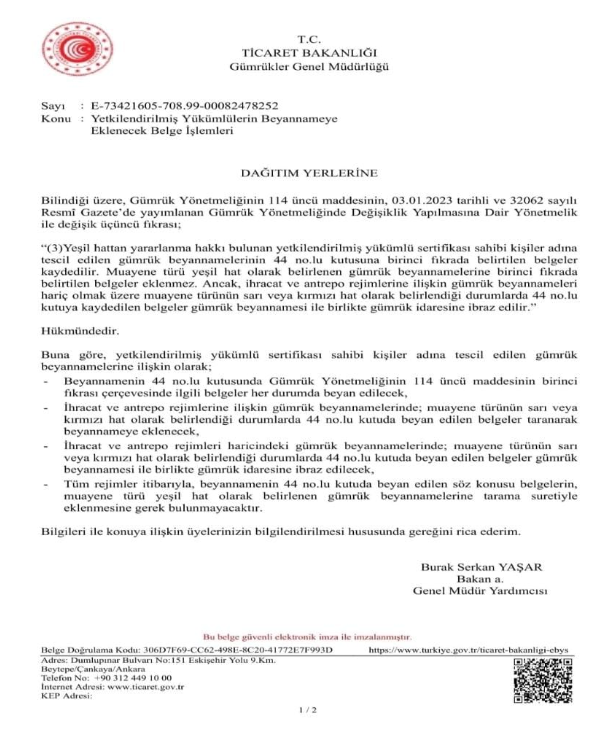
The article about the Documents to be Added to the Declaration by the Authorized Economic Operators has been published
As it is known, Article No. 114/3 of the Customs Regulation was amended as follows with the Regulation on Amendment of the Customs Regulation. The General Directorate of Customs has published an article on the subject.
“(3) The documents specified in the first paragraph are recorded in the box no. 44 of the customs declarations, registered on behalf of the persons who have the right to benefit from the green line. The documents specified in the first paragraph are not attached to the customs declarations, inspection type is determined as green line. However, except for customs declarations regarding export and warehouse regimes, in cases where the inspection type is determined as yellow or red line, the documents recorded in box no. 44 are submitted to the customs administration together with the customs declaration."Accordingly, regarding the customs declarations registered in the name of the persons holding the certificate of authorized economic operator;
- In box no. 44 of the declaration, the relevant documents will be declared in any case within the framework of the first paragraph of Article 114 of the Customs Regulation,
-In customs declarations regarding export and warehouse regimes; in cases where the inspection type is determined as a yellow or red line, the documents declared in box no. 44 will be scanned and added to the declaration,
- Customs declarations other than export and warehouse regimes; in cases where the inspection type is determined as yellow or red line, the documents declared in box no. 44 will be submitted to the customs administration together with the customs declaration, - For all regimes, it will not be necessary to add the said documents declared in box no. 44 of the declaration to the customs declarations, whose inspection type is determined as green line, by scanning.
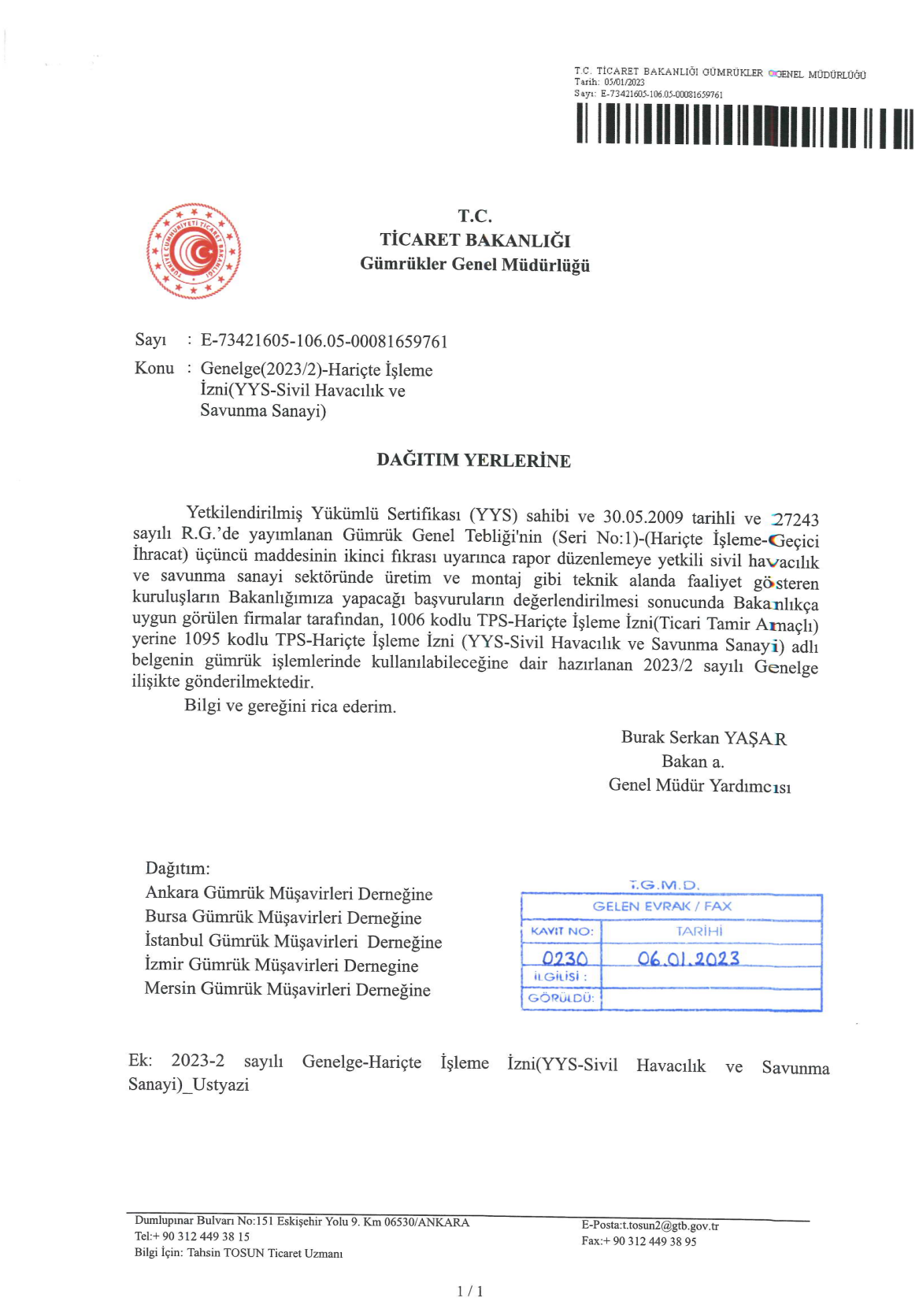
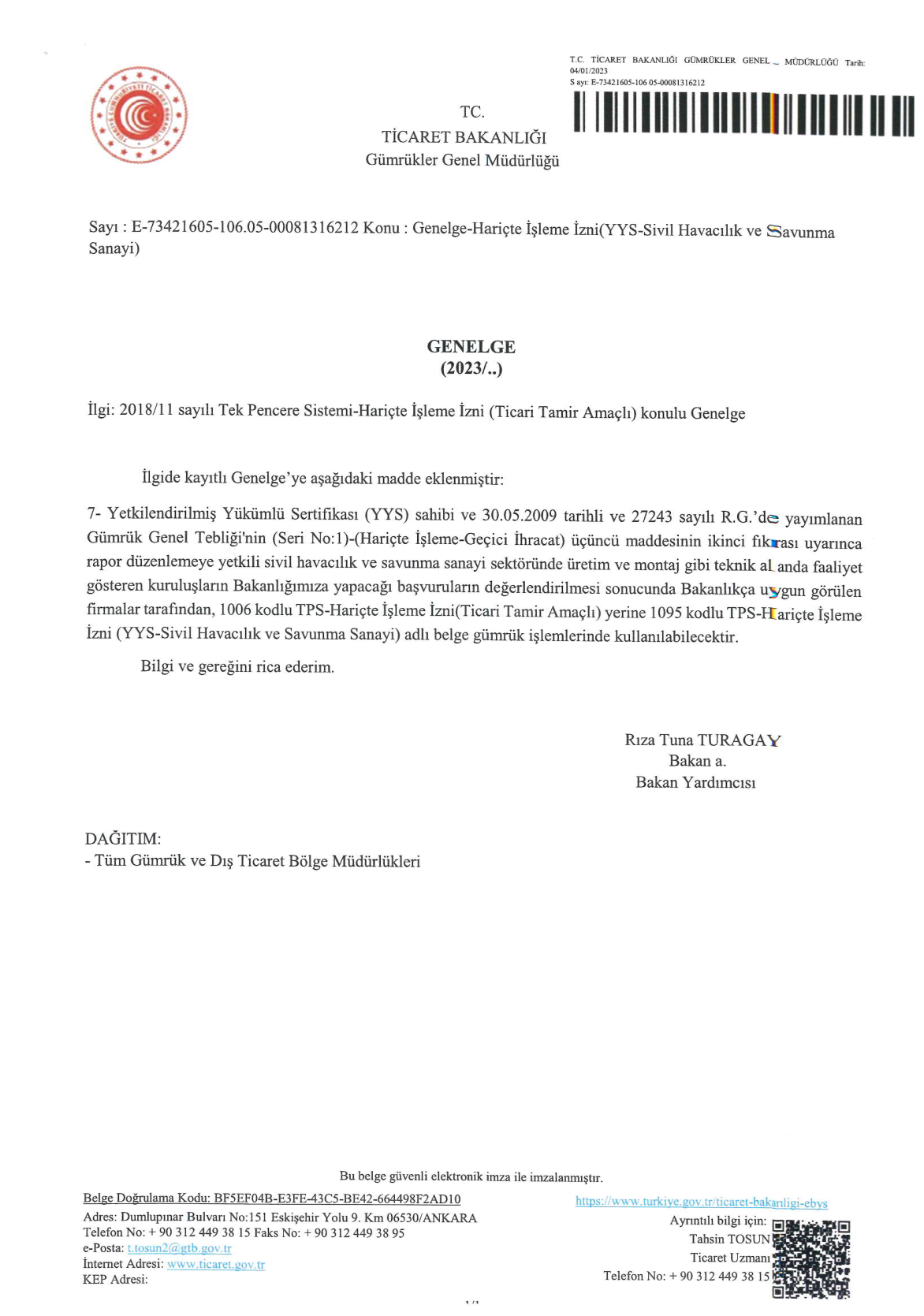
The following article has been added to the Circular No. 2018/11 on Single Window System-Outside Processing Permit (For Commercial Repair).
The following article has been added to the Circular No. 2018/11 on Single Window System-Outside Processing Permit (For Commercial Repair).
Civil aviation and defense, holding an Authorized Economic Operator Certificate (YYS) and authorized to issue a report in accordance with the second paragraph of the third article of the Customs General Communiqué (Serial No:1)-(Outward Processing-Temporary Export) published on 30.05.2009 and numbered 27243. As a result of the evaluation of the applications to be made by the organizations operating in the technical field such as production and assembly in the industrial sector to our Ministry, the companies deemed appropriate by the Ministry, instead of the TPS-Outside Processing Permit (For Commercial Repair Purpose) with the code 1006, TPS-Outside Processing Permit (YYS-Civil Aviation and Defense Industry) with the code 1095. ) can be used in customs procedures.
Priority Inspection for YYS Certificate
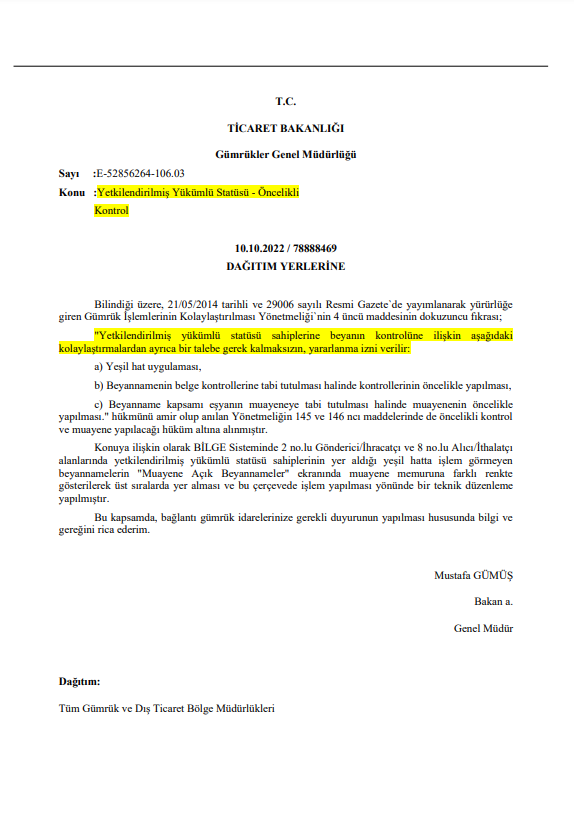
With the systemic regulation made in the BİLGE System, customs procedures of YYS companies' declarations that are processed on the yellow and red lines can now be completed with priority.
Regarding the subject, the declarations that are not processed on the green line, which includes the holders of the obligatory status, who are authorized in the areas of 2 Sender / Exporter and 8 No. A technical arrangement has been made to process the transaction.
Circular No. 2021/20-Operations to be Performed in Accordance with Article 234 of the Customs Code in the Application of Declarations with Incomplete Documents
The General Directorate of Customs of the Ministry of Commerce has published the Circular No. 2021/20 in order to eliminate the application differences experienced in the application of Article 234 of the Customs Code regarding the “declaration with a missing document” procedure of companies with YYS and OKS documents.
The General Directorate of Customs has published the Circular No. 2021/20 “Operations to be performed in Accordance with Article 234 of the Customs Code in the Application of Declarations with Incomplete Documents”.
In the circular, the missing document organized in the Regulation on the Facilitation of Customs Procedures and the Customs General Communiqué on the Status of an Approved Person (Order No. 1) was explained with examples of how to conduct operations at the point of application of Article 234 of the Customs Code as of the situations encountered in the application of the declaration (bs-1).
1 - Notification of the completion of documents with the incomplete document completion form
If the missing document is submitted within the completion form period and it is understood that the documents are duly and in accordance with the missing document specified in the declaration, there is no room for any penalty proceedings. If it is found that the documents in question cannot be submitted when requested to submit them (green line declarations), or the documents submitted are not compatible with the document specified in the first declaration, or are not duly in accordance with the documents, an additional tax amount to be calculated based on the absence of documents is accrued and a delay interest is applied. In addition, operations are carried out in accordance with Article 234 of the Customs Code.
2 - Notification of the obliged person that he will not be able to complete the documents within the period
In the event that the obliged person declares that he cannot complete the missing documents within the period, the obliged person will have completed his first statement in a way that requires changes to the declaration. As of the moment of the final declaration, there is no room for processing in accordance with Article 234 of the Customs Code, since there is no difference between the declared documents and the submitted documents. If a declaration is made in this way, an additional tax amount is accrued, which will be calculated depending on the case where there are no documents, and a delay interest is applied.
3 - Expiration of the prescribed period for the completion of documents
If the deadline for completing the missing documents has expired, but the obliged person has not submitted the missing document completion form and the missing documents, the obliged person must be considered to have kept the first statement as it is, but does not have the relevant documents. Because the obliged person has not taken any action within the period given to him, the declaration will be completed as it was first issued. It is not possible to accept the incomplete document completion form or the submitted document provided outside of this period. In this case, additional tax amount to be calculated based on the case where there are no documents is accrued and a delay interest is applied. In addition, operations are carried out in accordance with Article 234 of the Customs Code.
Please click here for samples and Circular.
About OKSB and YYS Applications
In the article of the General Directorate of Customs, it was stated that the inclusion of public receivables arising from penalties within the scope of the configuration does not constitute a reason for not being considered in the applications for the OKSB and YYS.
“In paragraphs (b), (c) and (ç) of the first paragraph of Article 23 of the Customs Regulation and in paragraphs (c ), (ç) and (d) of the first paragraph of Article 5 of the Regulation on the Facilitation of Customs Procedures, provisions on finalized customs penalties are not the provisions related to public receivables arising from these penalties, but the provisions related to violations of customs legislation that cause these penalties to occur. Therefore, public receivables arising from these penalties are included in the scope of the configuration and these penalties do not constitute a reason for not considering approved person status certificate and Authorized Economic Operator certificate applications.”
With the amendment to the Regulation on the Facilitation of Customs Procedures; the original or sample of the current signature circulars will not be required in the application for the Authorized Economic Operator certificate.
With the amendment to the Regulation on the Facilitation of Customs Procedures; the original or sample of the current signature circulars will not be required in the application for the Authorized Economic Operator certificate.
Explanation
With the amendment to the Regulation on the Facilitation of Customs Procedures; the original or sample of the current signature circulars will not be required for in the application for the Authorized Economic Operator certificate.
With the amendment made to the Customs General Notification on the Status of the Approved Person No. 1 series; Signature circulars were removed in applications for the status certificate of the approved person.
In the customs regulations, as amended; signature circular is not required for investment and operating permits for temporary storage permit applications and permits simplification in the applications; signature circular is not covered by customs broker’s associations-reported information and documents that are related to the changes.
With the amendment made to the Customs General Communiqué serial Transit Regime no 6: signature circulars will not be required in the application for the simplified transportation of goods by rail within the framework of the common transit and national transit regimes.
With the amendment made to the Customs General Communiqué serial Transit Regime no 5: signature circulars will not be required in the application for the simplified transportation of goods by air within the framework of the transit regime.
With the amendment made to the Customs General Communiqué serial Transit Regime no 3: company that will transit crude oil, gasoline, gas, naphtha, fuel-oil, and kerosene and jet fuel will not be required signature circulars when applying for a permit.
With the amendment made to the Customs General Communiqué serial Transit Regime no 4; in comprehensive coverage in applications for permits, signature circulars have been removed in applications for the right to a discount on comprehensive coverage, signature circulars have also been removed from the attached documents contained in the Comprehensive Guarantee and Security Waiver Permit Application Form.
With the amendment made to the Customs General Communiqué serial Transit Regime no 1; Signature circulars were removed from the documents contained in the petition in the application for a vehicle approval certificate.
With the amendment made to the Customs General Communiqué serial Transit Regime no 2: original/approved sample of the Signature Circulars was removed from the additional documents and Installment Request Form of the Customs General Communique.
According to the amendment made to the Regulation on Duty-Free Shops, Signature circulars will not be required from people who will apply for a store or warehouse opening permit during the application for a preliminary permit.
Authorized Receiver Shipment Operations
The General Directorate of Customs has published the attached article on "Authorized Receiver Shipment Operations".
Accordingly, if the owner of the goods arriving at the authorized receiver facility does not have the YYS-I status, the import operations of the goods cannot be carried out at the authorized receiver facility. In this case, following notice of the arrival and unloading of the goods, it has been reported that the transactions are to be continued as indicated in the heading "Partial Transactions Within the Scope of Article 117 of the Regulation dated 29.06.2020 On the topic " Receiver Transactions with Permission" specified in section 3 of the manual of 2020/13 Circular. In order to carry out these shipment operations, the authorized recipient must also have the authorized sender's authority.
The General Directorate of Customs has published a Circular on the inspection and line operations of export declarations to be processed within the scope of the authorization of the authorized sender.
In the circular it is stated that, with the application of paperless export, it becomes possible to parse the customs administration where the goods will be physically examined if necessary with the customs administration where the declaration is registered and without coming to the customs office, provided that the final exit point is an authorized sender facility, the scope of the opened export declarations is any transit declaration of the goods and it can be sent directly from the company's facility to the authorized sender facility connected to a different customs directorate without going to the customs administration by any vehicle without the need for seal exercises and accordingly it can be shipped abroad..
Export Implementation without Documents- Declarations in Blue and Green lines
In the attached article of the General Directorate of Customs:
The documents in Bilge System located in the field of documents requested by the system for reference purposes and it is declared that the declaration will be attached in the documents section covers documents that are already available on paper. Documents contained in a Single-Window System (Eg. E-invoice) there is no need to add electronically edited documents that have not been requested by the system for reference purposes to the declaration by scanning.
In this context, it was decided to take the pilot application of the regulations made in the BILGE System to be carried out at the Ankara Customs Directorate by 01.03.2021 and it is aimed to follow the course of the application and to spread it to all customs directorates on 01.04.2021.
Firms that own YYS will be less directed to TAREX risk analysis.
We would like to thank the General Directorate of Product Safety and Supervision, which has ensured the acceptance of the proposal we have made in our Association's petition on TSE audits No. 2020-4.
In letter published by the General Directorate of control and Product Safety numbered 24545304-553.02 and dated 13.11.2020, in applications made through the TAREKS system, if company has YYS certificate, compared to firms without having a certificate, risk analysis is made with privileges.
http://www.yysd.org.tr/upload/media_center/dokuman_1605538795.pdf
Regulation of the Industrial Registry Certificate in Electronic Environment
In the attached letter, it is stated that enterprises can complete all transactions electronically for registration to the industrial registry and receive their documents electronically, therefore, during the YYS and OKSB Applications, the electronic industry registration documents must be accepted through QR code verification as specified in the manual attached to the letter.
Pdf document for related article
YYS electronic guide
As of September 1, 2020, YYS applications will not be accepted in paper media and applications will be made in electronic media.
Within the scope of Circular No. 2020-17 on the subject, the YYS electronic guide has been published.
Click to view AEO Electronic Manual
For YYS applications
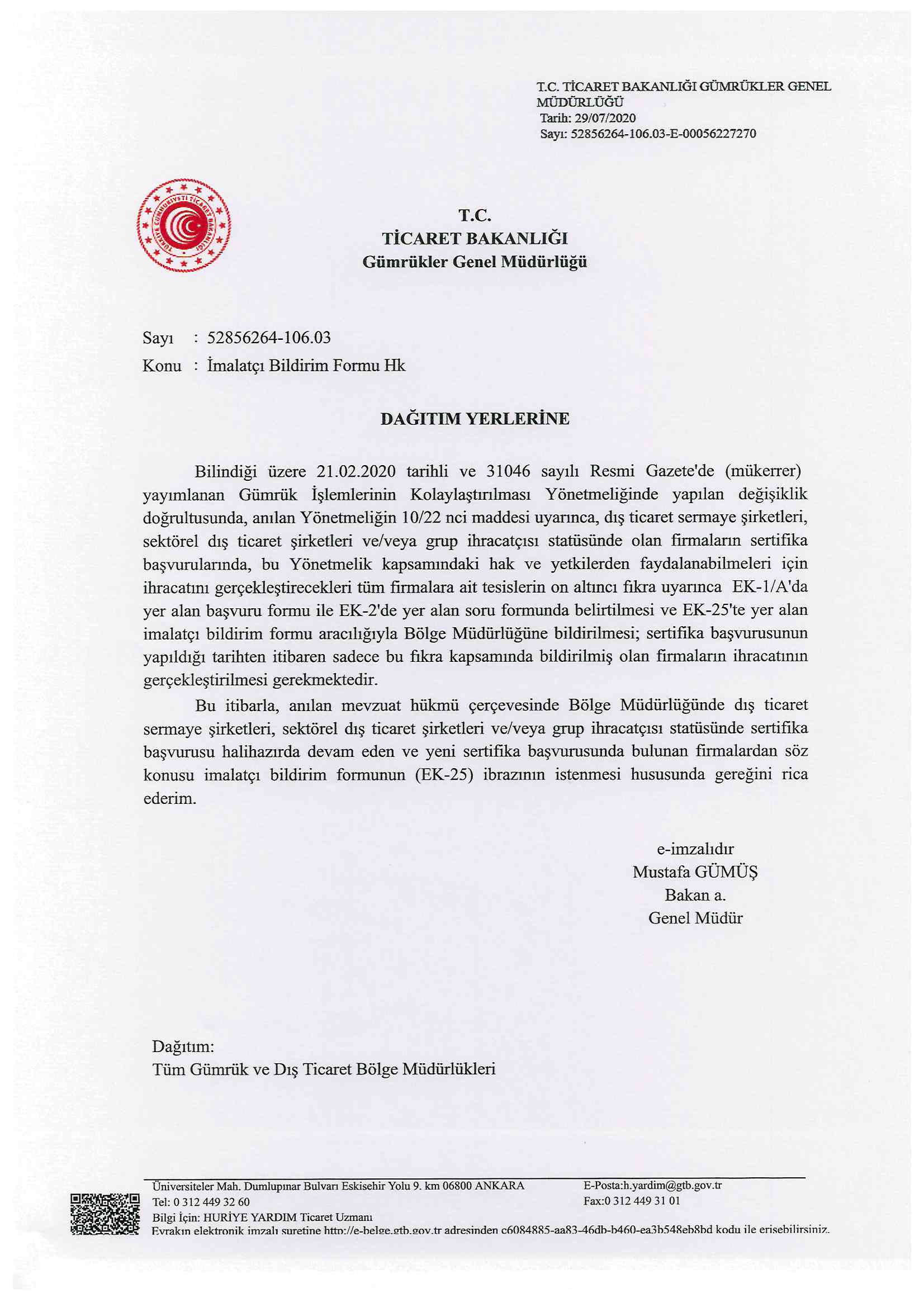
General Directorate of Customs published an article about "Manufacturer Notification Form" required for YYS applications.
In the article, in accordance with the amendment to the regulation on the facilitation of customs procedures made on 21.02.2020 it is specified as follows;
For foreign trading companies, sectorial foreign trade companies and/or companies with status of group exporter to benefit from rights and privileges under YYS in their certificate applications, it is required that all facilities of companies for which they carry out export operations must be specified in application form given in Annex-1/A and questionnaire for given in Annex 2 and reported to the Regional Directorate via manufacturer,
From the date of filing the certificate application, it is stated that only the exports of the companies notified in accordance with this paragraph should be carried out.

Authorized Economic Operator Certificate Electronic Application Procedures
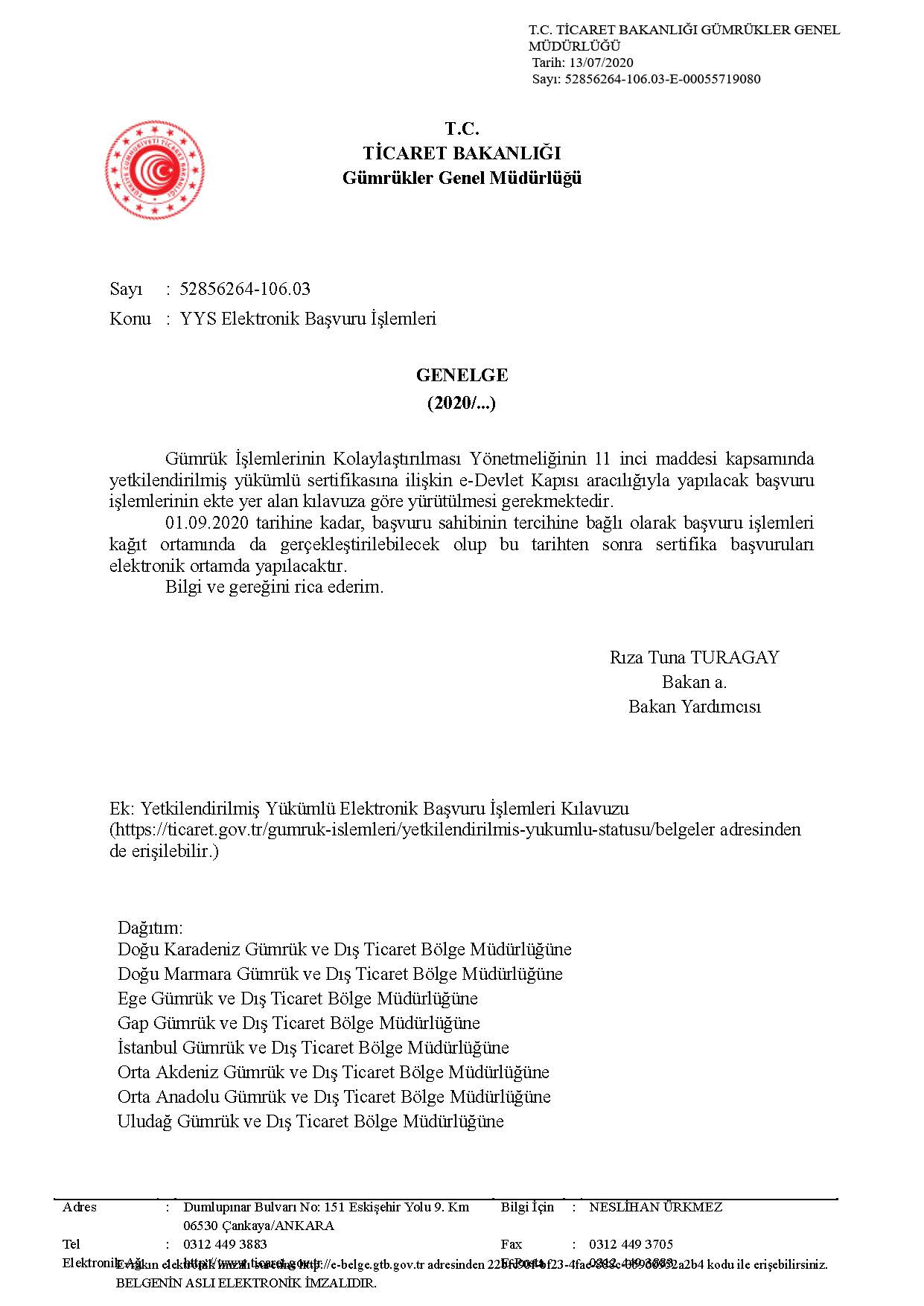
General Directorate of Customs issued a circular on “YYS electronic application procedures".
It is stated in circular that; in accordance with Article 11 of the regulation on the facilitation of customs procedures, the application procedures to be made through the “E-devlet kapısı” for the authorized economic operator certificate must be carried out in accordance with the prepared guidelines.
Until 01.09.2020, depending on the applicant's preference, application procedures can also be performed in paper media, but after this date, certificate applications will be made in electronic media.
Click here for Circular No 2020/17.
Click here for the YYS E-Application Guide.
“Authorized receiver operations” guide for operations within the scope of the authorized receiver application.
The “authorized receiver operations” guide for operations within the scope of the authorized receiver application has been published.
Coronavirus Measures - Authorized Economic Operator Applications
In the article published by the General Directorate of customs, it was published that the periods stopped for obligations should be continued from 30.06.2020, and the periods related to events that give rise to obligations in the articles specified after 19.03.2020 should also be started on 30.06.2020.
Communiqué on the Repeal of the Communiqué on the Monitoring Of Authorized Economic Operators
From The Ministry Of Commerce:
COMMUNIQUÉ ON THE REPEAL OF THE COMMUNIQUÉ ON THE MONITORING OF AUTHORIZED ECONOMIC OPERATORS
Article 1- Communiqué on the Monitoring of Authorized Economic Operators published in the Official Gazette dated 14/3/2017 and numbered 30007 have been repealed.
Article 2-This communiqué enters into force on the date of publication.
Article 3- The provisions of this communiqué are executed by the Minister of Commerce.
On-Site Customs Clearance Pilot Application for Imports
Article was published for starting import on-site customs clearance pilot application in Yalova Customs.
upload/media_center/yg.docx
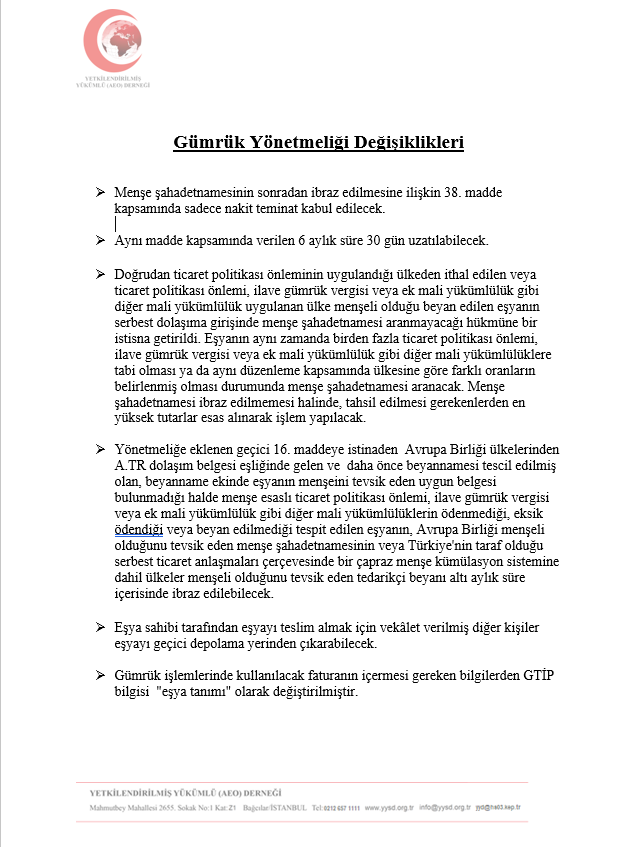
Customs Regulation Changes
Information circulars related to changes in customs regulations are added. Click here to download related circulars.

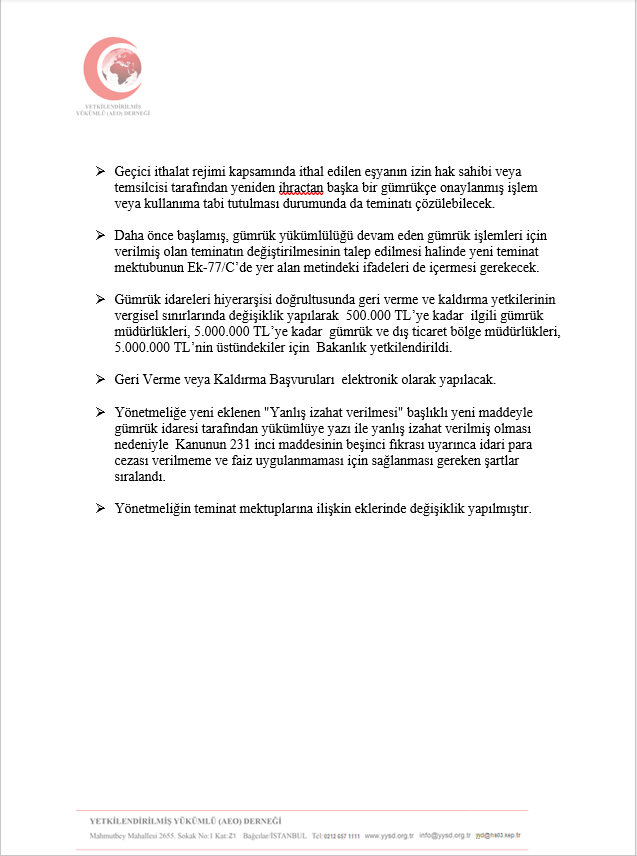
Reporting of Discrepancies Identified within the Scope of the Annual Activity Report
A circular was published stating that if there is a criminal situation after the annual reports are issued, the Relevant Customs Authority should be notified.
Reporting of Discrepancies Identified Within the Scope of the Annual Activity Report
Reporting of Discrepancies Identified Within the Scope of the Annual Activity Report
Documents have been determined according to requested permit in applications for approved exporter authority within the scope of regulation on facilitating customs procedures .
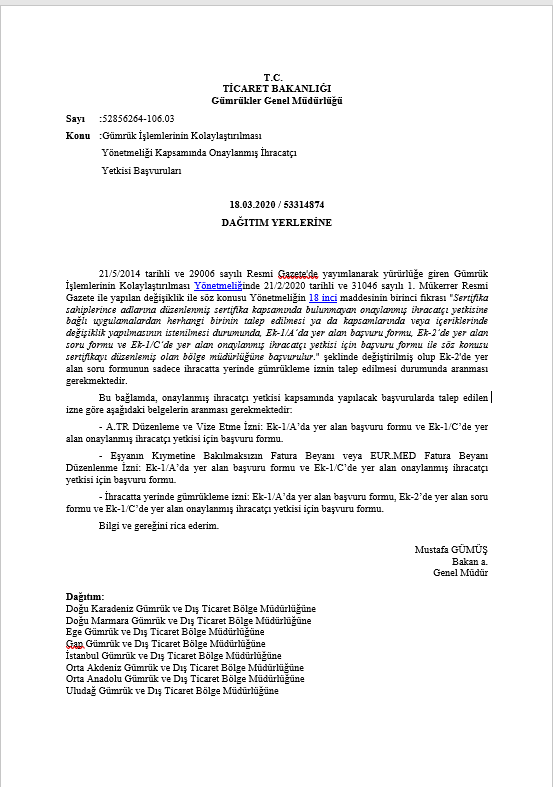
Within The Scope of Coronavirus Measures of General Directorate of Customs
Within The Scope Of Coronavirus Measures of General Directorate Of Customs; preliminary inspection activities of applicants, on-site inspection activities, change notices, lump sum guarantee presentation, annual activity report that give rise to obligations are stopped until a second notification as of 19/03/2020.
Amendment to the Regulation on the Facilitation of Customs Procedures
About amending the regulation on the facilitation of customs procedures, it was stated that with amendment updated the regulation software improvements were made for annex-24 and Annex-29 forms added to the Annex-2.
Amendment to the Regulation on the Facilitation of Customs Procedures
Companies with Authorized Economic Operator Certificate Traded On Green Line
The type of inspection for imports and warehouse declarations of companies having authorized economic operator certificate traded on the Green Line, notified to operator after a 20-minute waiting period following the registration of the declaration and monitoring import and warehouse declarations that are notified in a waiting period of 20 minutes by the relevant customs office through BİLGE → detailed declaration → TCGB Officer Operations → open declarations → import declarations section and it is stated that it is possible to change the line if it is deemed necessary during this time.
Summary of Changes in Customs Procedures Facilitation Regulation
Please click here to get summary information about the changes in the customs procedures facilitation regulation
Comparison table and statement notes of the Ministry of Commerce regarding the changes made in the regulation on the facilitation of customs procedures
A comparison table and statement notes of the Ministry of trade were attached to the changes made in the regulation on the facilitation of customs procedures.
Comparison Table
Comments on changes in the GIK
Questions, opinions and suggestions form in the regulation on the facilitation of customs procedures
Through the ministry's website, the proposal form for your questions and suggestions that you think should be made in the regulation on the facilitation of customs procedures has been implemented.
Annual Activity Report Submitted To Regional Directorates
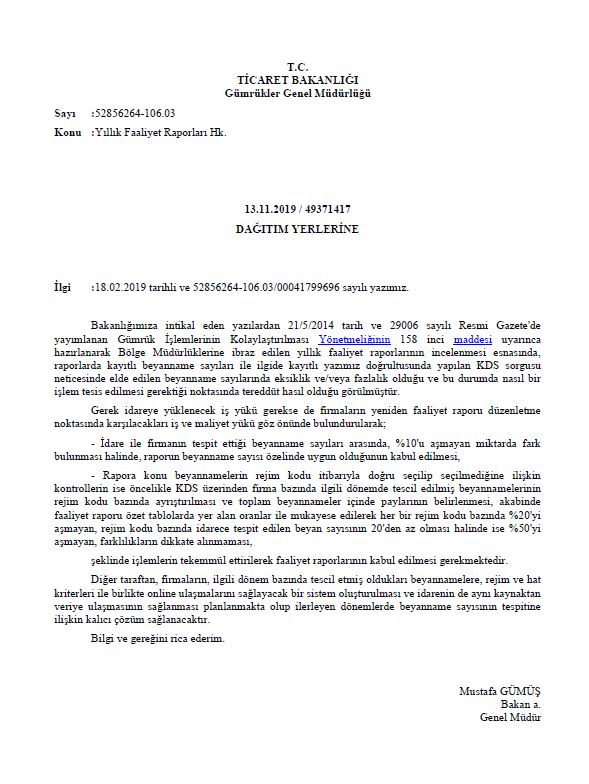
An attached article was published about the discrepancy in the number of declarations contained in the annual reports and the number of declarations of the KDS system.
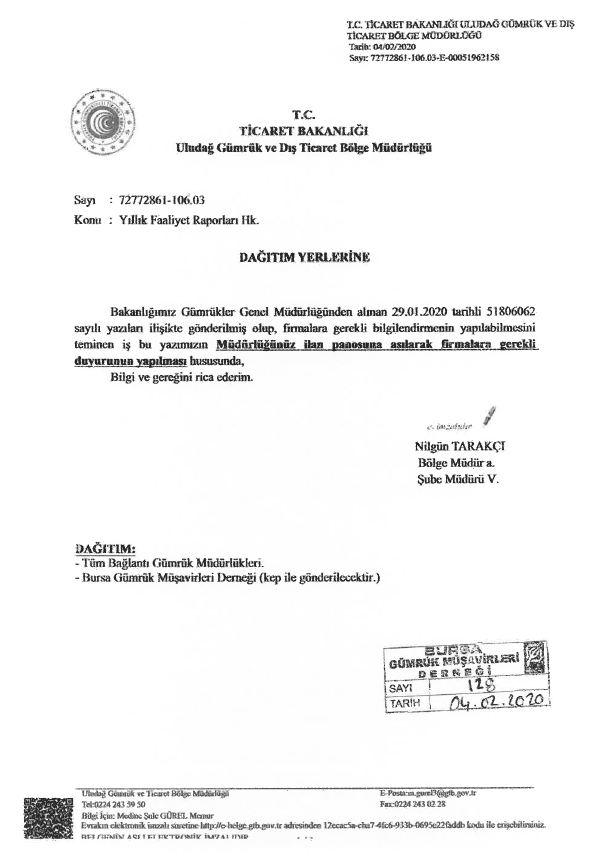

Discount on the Minimum Fee Tariff.!
25% discount may be applied to the minimum fee tariff for export operations of sectorial foreign trade firms, foreign trade capital companies, companies with authorized economic operator certificate, approved exporter authority and/or authorized obliged certificate.
Correction in closed declarations
Correction in closed declarations (Applications made in accordance with Customs Act 73/2 Article, article 121/4 of the customs regulation.- articles 161 / A of the customs procedures facilitation regulation )
About Annual Reports
In the article distributed by the General Directorate of Customs to the regional directorates, the annual activity reports submitted to the regional directorates are examined, the number of declarations registered in the reports and the number of declarations obtained as a result of the KDS query are missing and/or excess and our article about how to act in such cases is attached