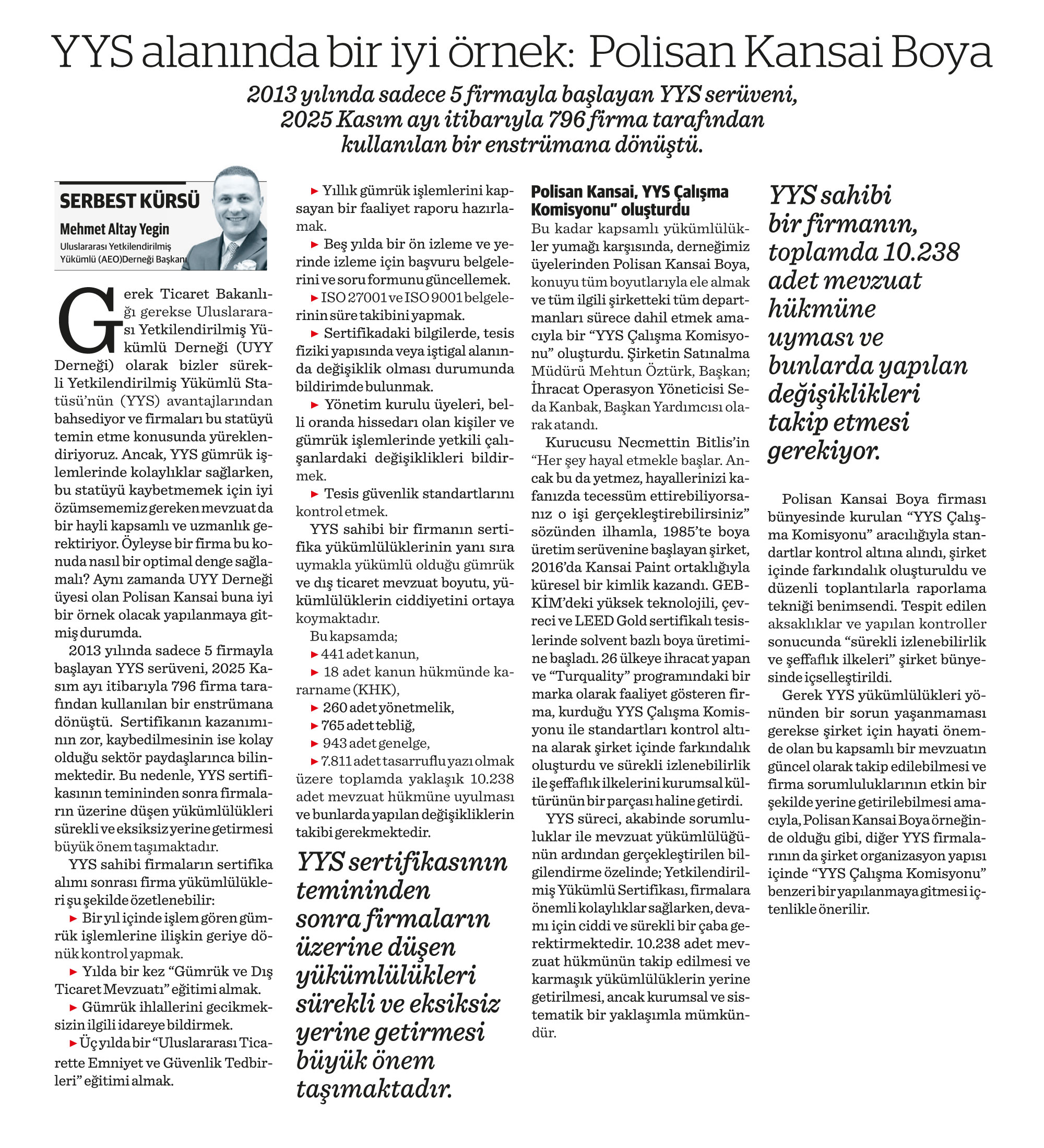
A GOOD EXAMPLE IN THE FIELD OF AEO: POLİSAN KANSAİ BOYA

Both the Ministry of Trade and the International Authorized Economic Operator Association (UYY Association) constantly emphasize the advantages of the Authorized Economic Operator (AEO) status and encourage companies to obtain it. However, while the AEO status provides significant facilitation in customs procedures, the legislation that must be thoroughly understood in order to maintain this status is quite extensive and requires expertise. So, how can a company strike an optimal balance in this regard? POLİSAN KANSAİ, which is also a member of the UYY Association, has established a well-structured example in this field.
The AEO journey, which began in 2013 with only five companies, has evolved into an instrument utilized by 796 companies as of November 2025. It is well known among industry stakeholders that while obtaining the certificate is difficult, losing it is relatively easy. Therefore, it is of great importance for companies holding an AEO certificate to continuously and fully meet their obligations after obtaining the certification.
The post-certification obligations of AEO-certified companies can be summarized as follows:
- Conduct retrospective control of customs transactions carried out within the past year.
· Receive "Customs and Foreign Trade Legislation" training once a year.
· Report customs violations to the relevant authority without delay.
· Receive "Safety and Security Measures in International Trade" training once every three years.
· Prepare an annual activity report covering customs operations.
· Update application documents and questionnaire forms for pre-audit and on-site audit every five years.
· Monitor the validity periods of ISO 27001 and ISO 9001 certificates.
· Notify any changes in certificate information, physical structure of the facility, or field of activity.
· Report changes regarding board members, shareholders with a certain share ratio, and employees authorized in customs operations.
· Inspect facility security standards.
In addition to these obligations, the dimension of customs and foreign trade legislation that AEO-certified companies must comply with further demonstrates the seriousness of these responsibilities.
Within this scope, compliance and monitoring are required for approximately 10,238 legislative provisions, including:
- 441 Laws
· 18 Decrees with the Force of Law (KHK)
· 260 Regulations
· 765 Communiqués
· 943 Circulars
· 7,811 Official Letters
These must all be followed meticulously, along with any amendments made to them.
IN THE FACE OF SUCH EXTENSIVE OBLIGATIONS, A MODEL INITIATIVE BY POLİSAN KANSAİ BOYA
In response to the extensive and intricate set of obligations that come with the AEO status, our association member Polisan Kansai Boya established an “AEO Working Commission” to address the issue comprehensively and to involve all relevant departments within the company in the process. Procurement Manager Mehtun ÖZTÜRK was appointed as Chairperson, and Export Operations Manager Seda KANBAK as Deputy Chairperson.
Inspired by its founder Necmettin BİTLİS’s words: “Everything begins with imagination. But that alone is not enough—if you can visualize your dreams vividly in your mind, you can make them real,” the company began its paint production journey in 1985. In 2016, it gained a global identity through its partnership with Kansai Paint, launching solvent-based paint production at its high-tech, eco-friendly, and LEED Gold-certified facilities in GEBKİM. Operating as a “Turquality” brand and exporting to 26 countries, the company has, through its AEO Working Commission, established internal awareness, ensured control over standards, and embedded the principles of continuous traceability and transparency into its corporate culture.
Following the certification process, responsibilities, and legal obligations, it is evident that while the Authorized Economic Operator Certificate offers significant conveniences to companies, maintaining it requires serious and ongoing effort. The monitoring of 10,238 legislative provisions and fulfillment of complex obligations can only be achieved through a corporate and systematic approach.
Through the AEO Working Commission established within Polisan Kansai Boya, the company successfully brought standards under control, raised internal awareness, and adopted a reporting methodology through regular meetings. As a result of the audits and identified discrepancies, the principles of continuous traceability and transparency were internalized as integral elements of the company’s structure.
To prevent any issues concerning AEO obligations, ensure up-to-date compliance with this extensive and critical legislation, and enable companies to effectively fulfill their responsibilities, it is sincerely recommended that other AEO-certified companies establish similar organizational structure such as an “AEO Working Commission” within their corporate framework, as exemplified by Polisan Kansai Boya.
Mehmet Altay YEGİN
Chairman of the Board
International Authorized Economic Operator (AEO) Association